PROPERTY PRESERVATION
Preserving luxury today protects its value tomorrow
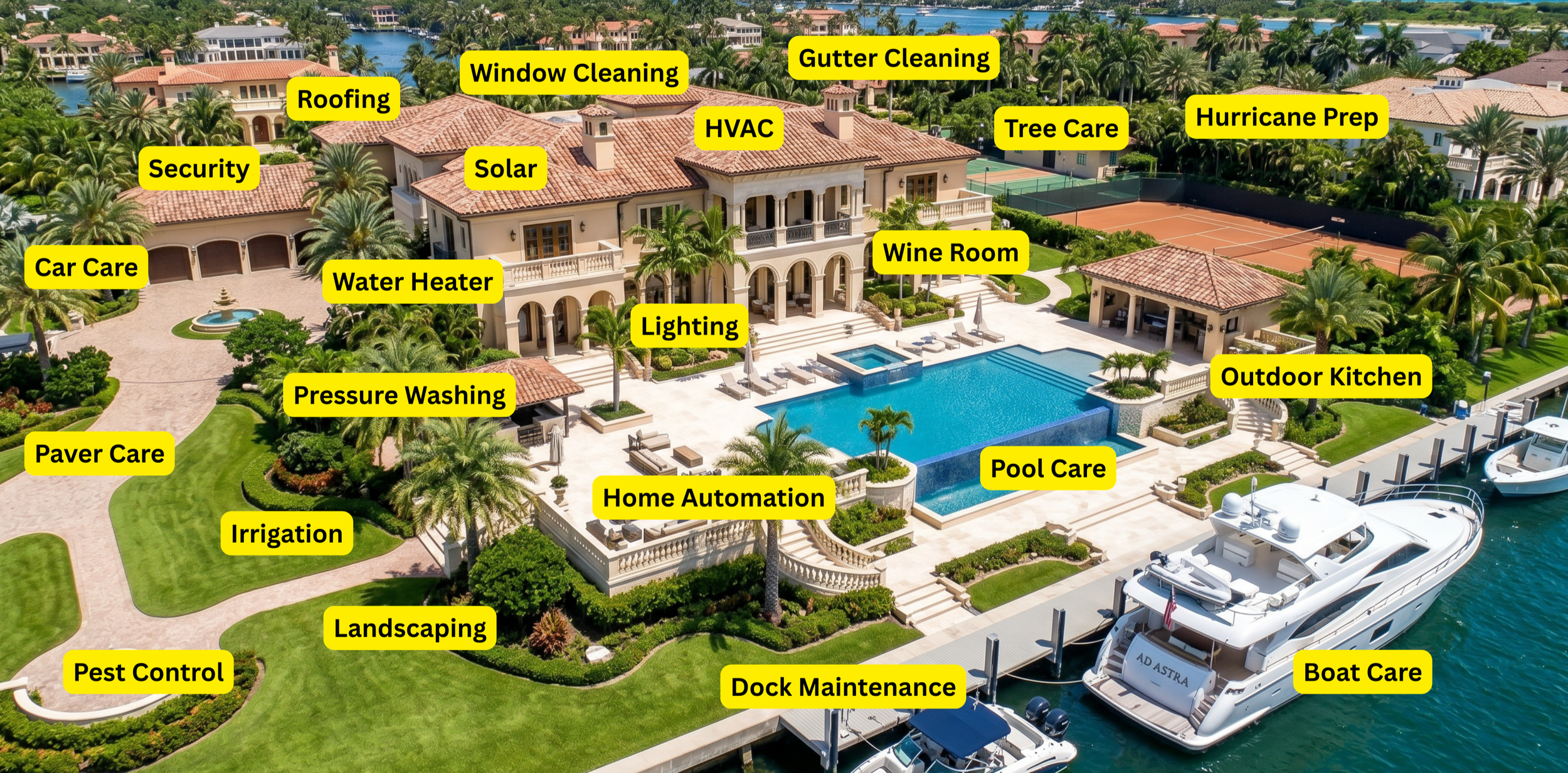
luxury assets require meticulous care
Detailed documentation & planning
And professional teams to manage them
A LUXURY HOME IS AN INVESTMENT IT SHOULD BE TREATED LIKE ONE
-
A luxury property is an appreciating asset yet so many people fail to provide the same managed care as they do with their luxury cars, which are usually depreciating assets.
Vehicle maintenance is effective because it follows a structured system. Oil changes are done at set intervals, tire rotations are scheduled, and brake inspections happen on a defined timeline. The owner knows exactly what’s coming, when it’s due, and what it’s likely to cost.
That consistency comes from centralizing responsibility. A single mechanic or garage acts as the system’s expert—overseeing diagnostics, scheduling service, and coordinating every aspect of upkeep. One point of contact manages the whole machine.
The outcome is straightforward: fewer surprises, controlled costs, and a longer usable life for the asset.
That level of structure is standard for something that loses value over time. It raises a fair question—why isn’t the same approach applied to appreciating assets like your home?
-
Your home is often your largest financial asset. Unlike a vehicle, which reliably loses value over time, a high-end property in Florida is designed to appreciate. That creates a simple but often ignored question: why isn’t it maintained with at least the same discipline as something far less valuable?
The consequences of neglect are immediate and expensive. Deferred maintenance accelerates deterioration, drives up repair costs, and can erode market value. In contrast, consistent, proactive upkeep supports long-term appreciation and prevents expensive failures.
There’s also the practical side. A properly maintained home operates smoothly. Systems are less likely to fail without warning, and small issues don’t spiral into emergencies that disrupt daily life. It functions as it should, without constant friction.
Despite that, many luxury homeowners still manage their properties reactively rather than systematically—unlike how they handle their vehicles.
-
A modern luxury home is not a single system but a network of complex, interdependent infrastructure—HVAC, electrical, plumbing, water heating, security, smart automation, integrated audio-visual systems, drainage, foundation, and roofing. Each requires specialized expertise, operates on its own maintenance cycle, and is typically managed by different vendors.
A vehicle has one primary technician overseeing the entire system. A luxury home has many.
That creates a coordination problem. Each specialist focuses only on their domain. HVAC providers don’t account for electrical load issues, plumbers don’t coordinate with smart home systems, and AV technicians rarely have visibility into mechanical service history. No one is responsible for the full ecosystem, which means interconnected systems are often maintained in isolation. Service schedules overlap, work gets duplicated or conflicts, and disruption becomes common.
The result is clear: despite being far more complex and significantly more valuable, luxury homes rarely receive the unified oversight that even a basic vehicle does.
That lack of integration is where inefficiency, unnecessary expense, and avoidable problems consistently emerge.
-
Strategic home oversight is the practice of managing a property with full awareness of every system—what exists, how old it is, its current condition, and when maintenance will be required. Instead of reacting to problems, it focuses on planning and coordination across all systems and service providers.
It comes down to four core elements:
Complete visibility:
A full inventory of all home systems, including age, condition, and expected service timelines.
Centralized records:
All maintenance history, vendor contacts, documentation, and schedules organized in one place.
Proactive planning: Maintenance is scheduled in advance and sequenced to avoid conflicts, downtime, and unnecessary disruption.
Integrated oversight:
A single coordinating function that understands how systems interact and ensures the right specialists are engaged at the right time.
The result is a home that performs reliably and efficiently—fewer surprises, smoother operations, and far better control over time, cost, and complexity.
-
There is no one answer for this as every luxury home and insurance situation is different.
However, multi-million dollar estates usually do require rigorous, documented preventative maintenance to maintain insurance coverage, often to a much higher standard than typical homes.
While insurance covers sudden, accidental damage, it does not cover damage resulting from neglect, wear and tear, or long-term deterioration.
Insurers for high-value homes, such as Chubb, PURE, or AIG Private Client Group, often require proactive maintenance to protect their high-value assets.
-
Preventing Claim Denials:
If a $50,000 floor is ruined by a water leak from a pipe that showed signs of corrosion for years, insurers may deny the claim, arguing the damage was caused by neglect, not a sudden accident.
Insurability and Renewals:
A lack of regular maintenance can lead to increased premiums, or in some cases, cancellation of the policy entirely.
Specialized Systems:
Modern, large estates often feature complex, integrated technology (climate control, smart systems, security) that require ongoing, professional maintenance to prevent failures.
-
Document Everything:
Keep a strict, detailed log of all maintenance activities, inspections, and repairs, including receipts and before-and-after photos.
Use Professionals:
Luxury property managers or specialized contractors should be used for maintenance to ensure it meets high standards.
Proactive Risk Management:
Implement loss cotroll measures, such as installing security, fire, and water protection systems, which can sometimes reduce premiums.
Regular Appraisals:
Professional appraisals (every 3–5 years) ensure the coverage limits match the current, true replacement cost of the estate.
-
IteInsurers of high-value homes focus on preventing large-loss incidents, including:
Water Damage Prevention:
The most common cause of claims, necessitating regular inspections of roofs, gutters, plumbing systems, and the installation of automatic water shut-off systems.
Structural Integrity:
Regular inspection and care for custom finishes, historical elements, and high-end exterior materials.
Mechanical Systems:
Routine servicing of HVAC and electrical systems to prevent fire and catastrophic failures.
Groundskeeping & Security:
Security is critical, requiring functional systems and managed landscaping to minimize risks.